
Social Nature and the Ecological Crisis: The Collapse Logic of Capitalist Modernity
Introduction
The ecological crisis is often treated as a technical problem, a failure of environmental policies, or a side effect of industrialization. Yet the issue is far more fundamental. The destruction directed at nature stems from the ontological structure of capitalist modernity. This structure separates humans from nature, elevating humans to the position of “master” and reducing nature to an “object.” In this way, the ecological crisis is not a crisis of nature, but a crisis of mentality.
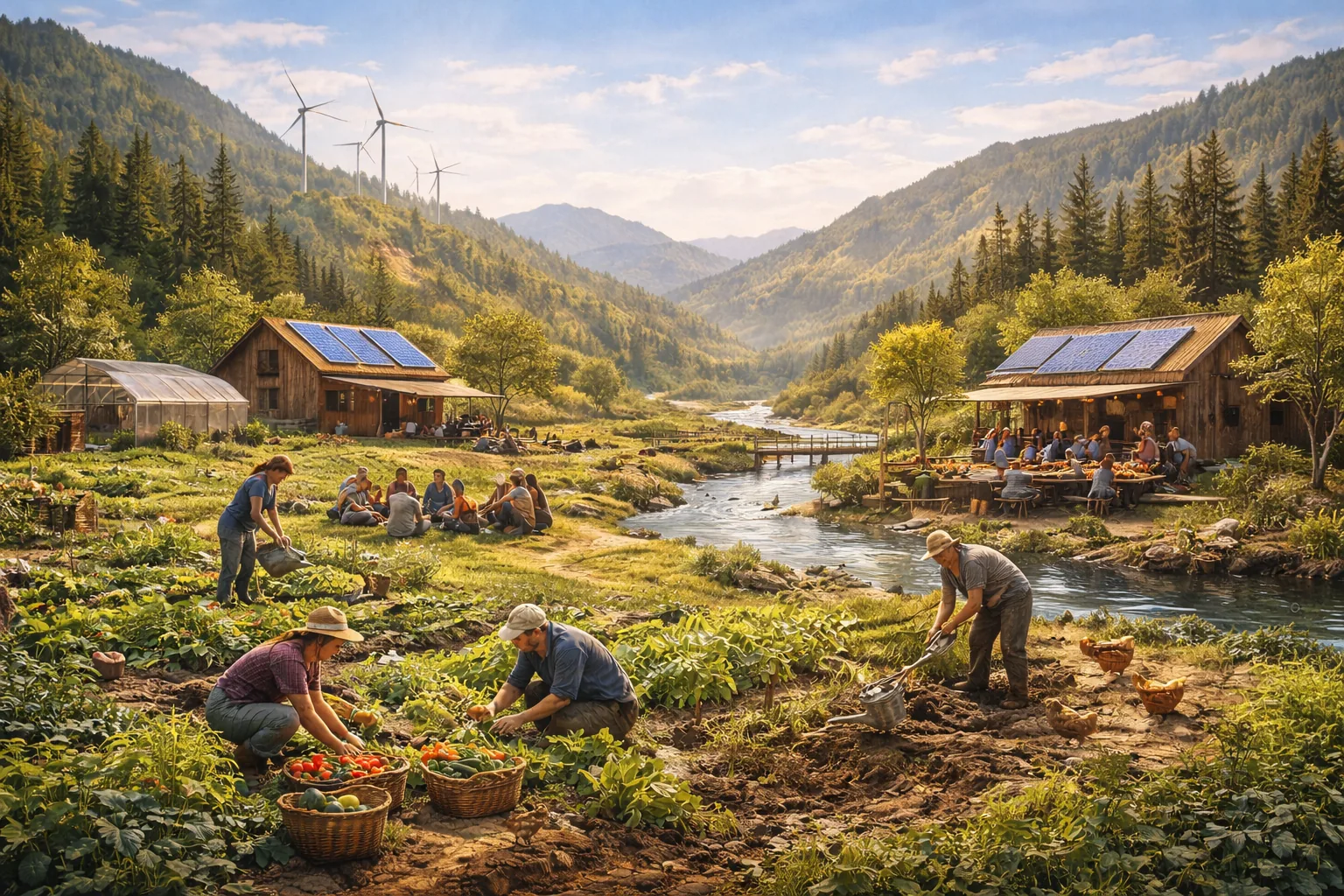
From the perspective of democratic modernity, nature is not a “resource” standing opposite humanity; it is a unity of social nature that exists together with humanity. Therefore, ecology is not merely a matter of protecting the environment, but of questioning the paradigm of civilization itself.
I. Rupture from Nature: The Ecological Foundation of Hierarchy
The construction of civilization begins not only with class formation and state formation, but also with the transformation of the human–nature relationship. Hierarchy becomes institutionalized first within human communities and then over nature. The idea of domination over nature develops in parallel with domination over women and society.
This mentality strips nature of being a living field of existence and turns it into an object that can be measured, sold, and controlled. Nature thus becomes the raw material for surplus production and the ground for capital accumulation.
Capitalist modernity deepens this process on an industrial scale. Energy policies, mining, mega-cities, industrial agriculture, and the fossil-fuel economy consume nature at an irreproducible speed. This is not only the disintegration of ecosystems, but also the unraveling of society.
II. Capitalist Modernity: The Ecological Impossibility of Endless Growth
The fundamental principle of the capitalist system is unlimited growth. But nature is limited. This is where the contradiction begins.
The growth imperative means:
• constant increases in production,
• constant expansion of consumption,
• constant demand for energy,
• constant urbanization.
This logic tears nature out of its own cycles. Soil becomes infertile, water is polluted, air is poisoned. The climate crisis is the visible face of this structural contradiction.
Capitalist modernity presents ecological destruction as a “technical problem that can be solved with technology.” But the problem is not a lack of technology; it is a problem of mentality and system. As long as capital accumulation continues, domination over nature will continue as well.
III. Social Nature: Rebuilding Ecological Ethics
In the approach of democratic modernity, humans and nature are not opposites, but intertwined fields of existence. Society is nature in a form that has gained consciousness. Therefore, an attack on nature is also an attack on society.
Ecological consciousness is not merely “environmental sensitivity”; it is the foundation of the moral–political society. A moral society aligns production and consumption with the balance of nature.
Within this understanding:
• the economy is organized not for profit, but for life;
• production is planned on a local and communal scale;
• energy policy is not centralist, but based on local self-governance;
• nature is not property of the market, but a common wealth of society.
Ecological transformation is possible not through state-centered reforms, but through social self-organization.
IV. Ecology and Democratic Confederalism
Democratic confederalism proposes a social model based on direct democracy and organized from the local level. In this model, ecology is not a subtopic; it is a constitutive principle.
Communes and assemblies:
• determine agricultural policies locally,
• supervise the use of natural resources,
• shape urban planning according to social needs,
• develop ecological education programs.
Ecology is the third pillar of democratic confederalism, considered together with women’s freedom and direct democracy. Because domination over nature and domination over women arise from the same mentality.
V. Perspective of Solution
The ecological crisis cannot be solved through system-internal adjustments. The solution requires:
- abandoning the centralist development model,
- strengthening the communal economy,
- local self-governments assuming control over natural resources,
- overcoming the culture of consumption,
- rebuilding the moral–political society.
An ecological society is not only a “greener” society, but a freer society.
Conclusion
The ecological crisis points to the historical limit of capitalist modernity. A civilization that wages war on nature cannot sustain its own existence. Democratic modernity offers a paradigm of society reconciled with nature—one that prioritizes life against hierarchy, domination, and the ideology of limitless growth.
Ecology is not the existential question of the future; it is the existential question of today. Society will either become free together with nature, or collapse together with the system.
Author: Azad Badiki – kurdbe.com Editorial Team
Date: 23.02.2026