
The Order of a Thousand Kings: The Anatomy of Rigid Centralism
DEMOCRATIC AUTONOMY – I
Abdullah ÖCALAN
1 – Urban, Local and Regional Autonomy: A Critique of Nation-State Rigid Centralism
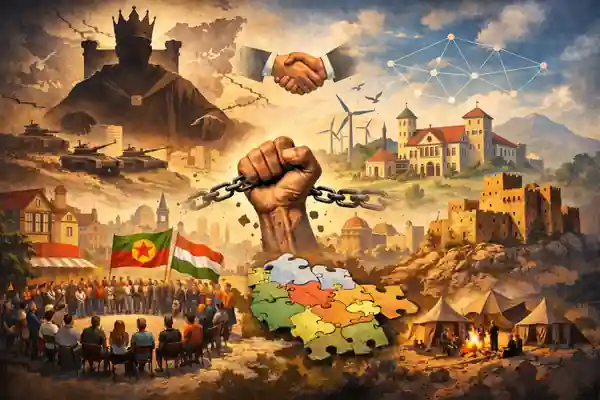
Throughout history, urban, local and regional autonomous administrations—always of great weight—have been among the other very important cultural traditions sacrificed by nation-statism. In all forms of social and state governance that have been practiced, cities, localities and regions have always had their own distinct administrations and autonomies. Indeed, it would otherwise be impossible to govern large-scale states and empires in particular. Rigid centralism is essentially a nation-state disease, a monopolistic character of modernity. It was imposed as a requirement of the law of maximum profit. It was designed so that the bourgeois bureaucrats of the middle class—growing like a tumor—could become power holders. It was developed as a model that functions only through fascism, in order to establish not one, but a thousand orders of kings.
As the dissolution of classical modernity accelerated, and as cultural movements—mostly liberal in character though some signifying radical rupture—developed in the form of postmodernity, the greatest share of this process was carried on the shoulders of movements for urban, local and regional autonomy. In fact, what is at stake is a return to, and revival of, cultures that have long lived strongly across political, economic and social dimensions throughout the ages. These movements are among the foremost of those with very important historical-social meaning, and that ought to have such meaning. Without the liberation of the city, the local and the region, liberation from the nation-state disease is not possible. Those who best understood this and put it into practice are the members of the European Union. Both the four hundred years of barbarism experienced under the name of modernity and the First and Second World Wars have given European culture a sufficient lesson. It is no coincidence that the first steps they implemented were laws of urban, local and regional autonomy. This relates to their understanding of what kind of extermination nation-statism represents for all cultural existences, above all genocide.
2 – The European Union Experience and Autonomy Trends in the World
Today, the most valued work within the European Union being carried out under the scope of urban, local and regional cultures is among the most important elements in resolving all global problems. Even if it is not overly radical, it is an important and necessary cultural movement. Since a uniform central governmental homogeneity could not be fully imposed and developed across all continents of the world, the autonomies of many cities, localities and regions had already preserved their vitality. From the Russian Federation to China and India; from the entire American continent (the USA is federal, autonomy is widespread in Canada, Latin America is already in a position of regional autonomy) to Africa (in Africa, states cannot form and be governed without traditional tribal and regional administration), autonomous positions and autonomy efforts are among the most active and current issues. The rigid centralist disease of nation-statism is applied in some Middle Eastern states whose numbers are limited, and in other dictatorships.
3 – Autonomy Developing Intertwined with the Democratic Nation and Confederalism
The dissolutions experienced by rigid-centralist nation-state structures—one of the most important dimensions of classical modernity—due to being squeezed from above by global capital and from below by cultural movements, are most often attempted to be replaced by urban, local and regional autonomous administrations. This increasingly strengthening tendency of our age has to develop intertwined with the democratic-nation movement as well. The democratic nation, as a form of governance, is very close to confederalism. Confederalism is, in a sense, the political form of governance of democratic nations. A strong city can gain existence only through local and regional autonomous administrations. In terms of governance form, the two movements are identical and overlap. Democratic nation-building and nations cannot gain governing power without urban, local and regional autonomies. Either they fall into chaos and disintegrate, or they are overcome by a new model of nation-statism. In order not to fall into either situation, the democratic nation movement must develop democratic autonomies at the urban, local and regional levels. Conversely, urban, local and regional autonomous administrations need to integrate with the democratic national movement as a democratic nation, in order not to be swallowed entirely and to fully use their economic, social and political powers. The excessively centralist power monopolies that nation-statism keeps at the door and imposes on both movements can be overcome only through a solid alliance between them. Otherwise, both movements—and even as phenomena—cannot be saved from being liquidated and dissolved under the threat of homogenization again, as they have often experienced in the past. If historical conditions in the 19th century favored nation-statism more, today’s conditions—21st century realities—favor democratic nations and urban, local and regional autonomous administrations empowered at every level.
4 – Urban Autonomies from the Middle Ages to the 19th Century and the Tradition of Resistance
In the Middle Ages, similar policies of urban autonomy could be implemented even more widely. It is as if we are faced with a starry world of cities resisting great empires. From Islamic empires (Umayyad, Abbasid, Seljuk, Timurid, Mughal, Ottoman) to the Mongol Empire of Genghis; from Christian empires (Byzantine, Spanish, Austrian, Tsarist Russia, British) to Chinese empires, hundreds of cities—stretching from the Pacific to the Atlantic, even to the American continent, and from the Great Sahara to Siberia—were able, in the name of autonomy policy, to resist when necessary until being erased from history. A similar example to Carthage being turned into a field is the city of Otrar, which resisted Genghis Khan; it too was turned into a field. Hundreds of examples can be offered of the centuries-long resistance of European cities both against imperial powers and against the centralism of nation-statism. It is very well known that especially the cities of Italy and Germany displayed great resistance until the mid-19th century to preserve their autonomous structures. Venice and Amsterdam are famous examples.
In the 19th century, the nation-state’s victory everywhere dealt a major blow to urban autonomies that had endured for thousands of years in history. However, with postmodernity, urban autonomies are becoming widespread again. Urban politics comes to the fore.
5 – Autonomy Resistances of Tribes, Clans and Religious Communities
In history, not only urban politics but perhaps even more so tribes, clans, religious communities, philosophical schools, etc., as major social groups, have displayed countless resistances in order to remain an autonomous political power against the forces of civilization. The three thousand five hundred-year (1600 BCE to the present) autonomy story of the Hebrew tribe is perhaps the most famous example. The autonomy politics of the Hebrew tribe played a decisive role in Jews being very wealthy and creative throughout history, and even more so today. Against Islam being transformed into an instrument of empire and power, very great sects of resistance emerged. The Alevi and Kharijite sects reflect the autonomous living politics of tribes and clans. The widespread oppositional sectarian upsurges seen within every people against Sunni sovereignty and the sultanate tradition are, in essence, the result of the resistant and libertarian politics of tribal and clan peoples. They are, in a sense, the first freedom and independence movements of peoples against Sunni Islamic colonialism. There are many similar sects of resistance in Christianity and Judaism as well. The Middle Ages, from beginning to end, passed full of struggles for freedom and autonomy by such local, urban, tribal and religious communities. The three hundred-year semi-secret resistant monastic life of the first Christian communities played the leading role in preparing contemporary civilization. The autonomous politics of the philosophical schools of Ancient Greece played the foundational preparatory role of science. The peoples and nations that have reached the present owe this reality most to their tribal and clan ancestors who resisted for hundreds and thousands of years on mountain tops and in the middle of deserts.
Modern national liberation movements are the continuation of these traditions. Even if they were distorted into independent states, the aim they all pursued was political independence. Although liberalism’s turning political independence into a false nation-state independence keeps politics from its true function, it still signifies the continuation of a very important tradition of political resistance.
To be continued.