
A Society Cannot Be Built Without Making Peace with Nature: Democratic Autonomy and Ecological Ethics
Introduction
The question of ecology is often discussed under headings such as environmental pollution, climate change, or energy policies. Yet the problem is not the technical protection of nature; it is which mentality forms the basis of the human–nature–society relationship. The approach of democratic autonomy aims to rebuild this relationship.
Society is not an entity separate from nature. Humans are nature in a form that has gained consciousness. Therefore, every form of domination directed at nature is a form of destruction directed back at society itself. The ecological crisis is, in fact, the outward expression of a social crisis.
I. The Mentality of Domination and the Objectification of Nature
With the processes of hierarchy and state formation, nature was removed from being a subject and objectified. Nature is no longer seen as a living whole, but as a controllable “resource.” This approach forms the mental ground that makes surplus production and capital accumulation possible.
Capitalist modernity institutionalized this mentality on an industrial scale. Nature has been turned into:
• an energy reserve,
• a depot of raw materials,
• an object of consumption.
This objectification is not only economic; it is cultural and ideological. As humans position themselves as the “master” of nature, relations of domination within society are also legitimized.
II. Democratic Autonomy: Rebuilding Relationships
Democratic autonomy is not merely an administrative model; it is the reconstruction of a system of relationships. The individual–society, society–nature, and woman–man relationships are addressed together.
Within this framework, ecology is defined as:
• not a state policy,
• a field of social consciousness,
• a moral–political responsibility.
Autonomy means society directly governs its own living spaces. Decisions over nature are also made through these mechanisms of direct participation. In this way, nature enters the sphere of responsibility of local communities, not bureaucratic plans.
III. Ecological Ethics: The Measure of Life
Ecological ethics is the principle of living in harmony with nature. This principle is built upon:
• production limited to needs,
• a sharing-based economy,
• responsibility toward future generations.
The moral–political society questions the culture of consumption, because limitless consumption dissolves not only nature but also social bonds. Ecological ethics requires humans to reposition themselves as part of nature.
Without this consciousness, democratic autonomy remains merely an institutional arrangement.
IV. Ecology, Women’s Freedom, and Social Defense
There is a historical parallel between domination over nature and domination over women. Both are the first targets of hierarchical mentality. Therefore, democratic autonomy addresses women’s freedom and ecology together.
The concept of social defense is not only military; it includes ecological defense. Protecting water sources, defending forests, collective resistance against the poisoning of soil—these are forms of defense of a democratic society.
Ecological defense is the defense of life.
V. Building an Ecological Society
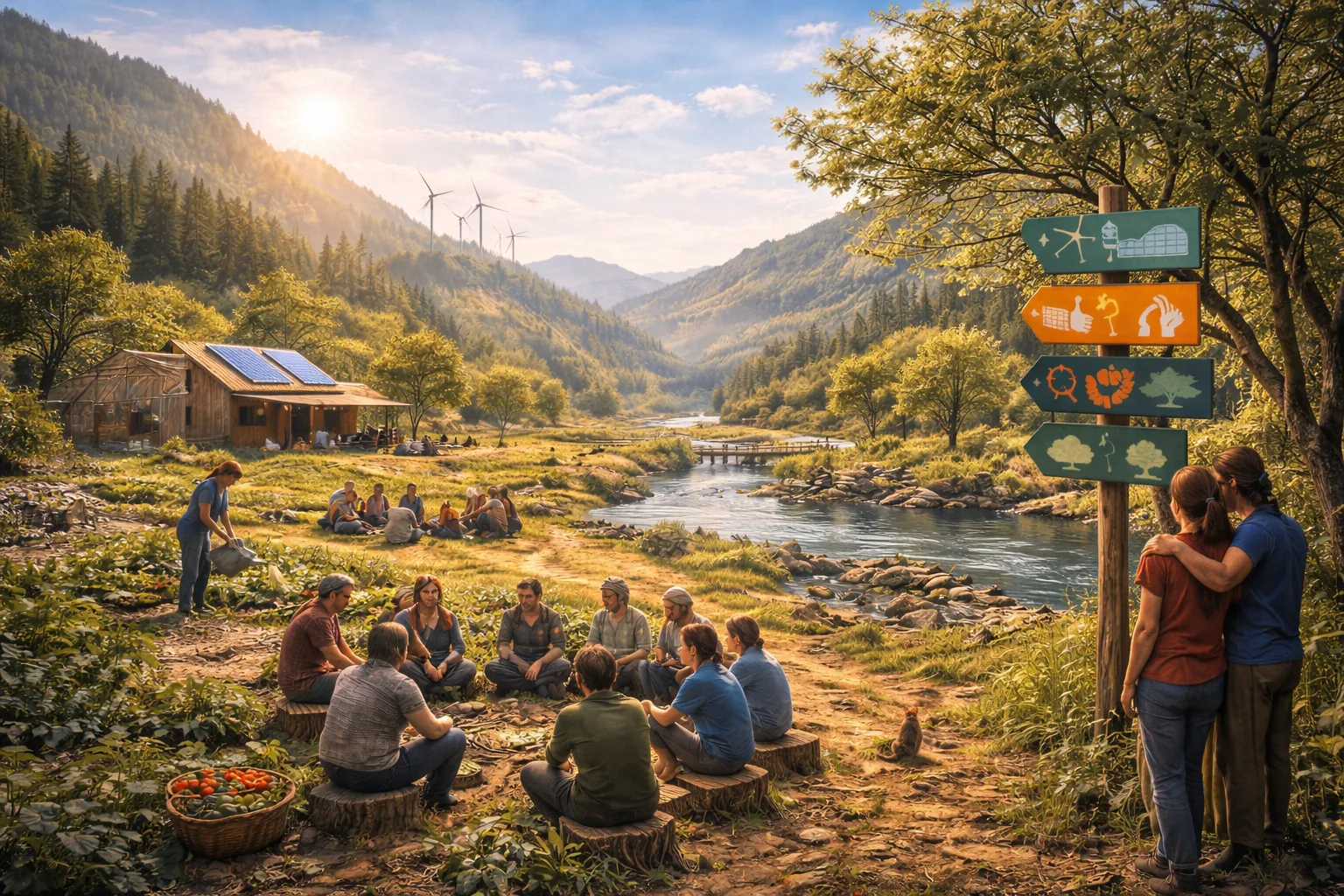
The model of democratic autonomy proposes a social structure in harmony with nature:
• local production networks,
• cooperatives,
• ecological agriculture,
• renewable energy,
• communal decision-making mechanisms.
This structure replaces centralized development plans with planning based on local needs. Thus, nature is removed from the logic of capital and becomes a common wealth of society.
An ecological society does not only protect nature; it also liberates human beings.
Conclusion
A democratic society cannot be built without making peace with nature. The ecological crisis reveals the historical limit of capitalist modernity. Democratic autonomy offers a paradigmatic framework to overcome this limit.
Ecology is not an environmental issue; it is an issue of freedom. A society that is not in harmony with nature cannot sustain its existence. Democratic modernity aims to overcome this dead end by rebuilding the unity of nature–society–humanity.
Ecological ethics is the conscience of the democratic society.
Author: Azad Badiki – kurdbe.com Editorial Team
Date: 09.03.2026