
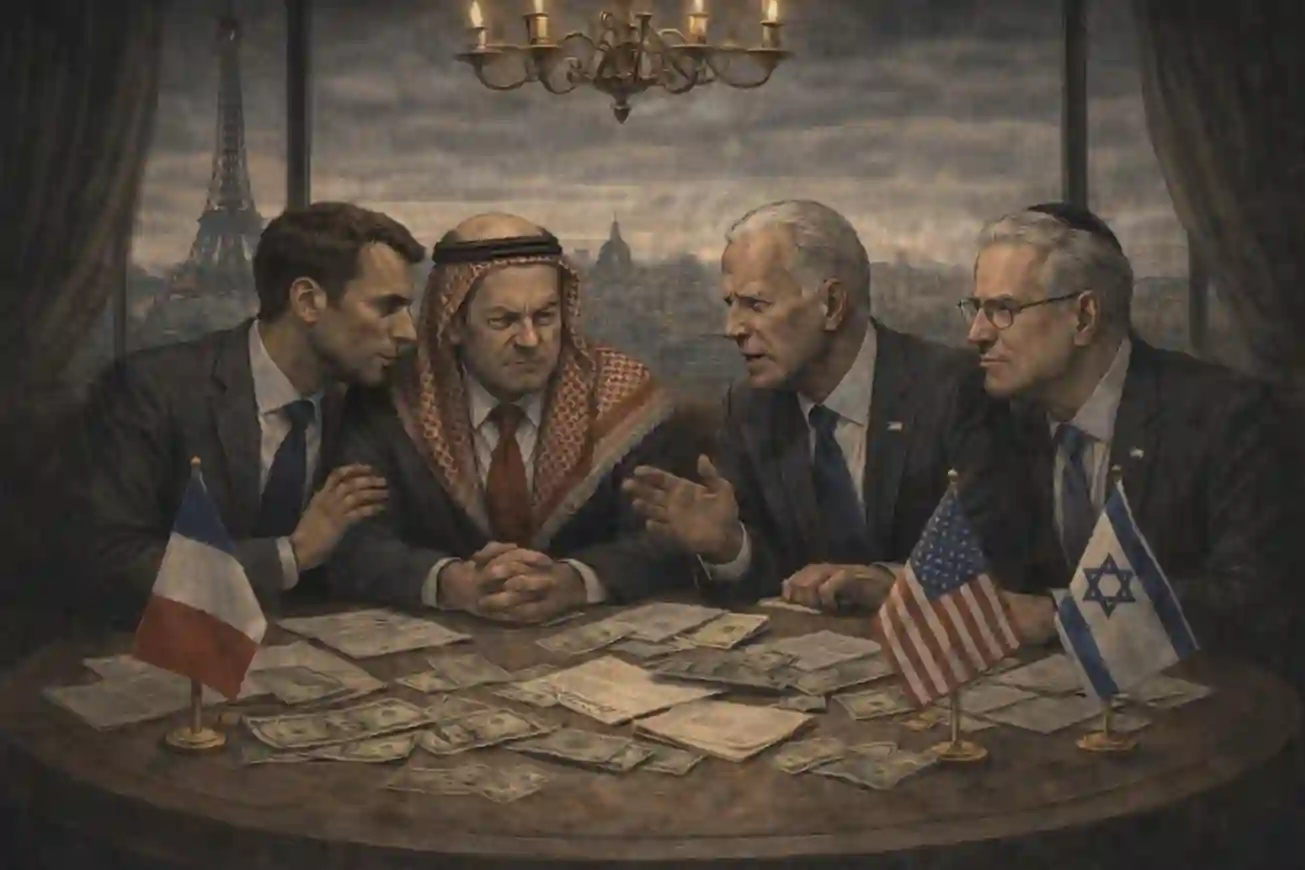
In the first section, we read the chain of war in the Middle East step by step. There, we identified three main engines: remnants of the Baath, proxy networks, and the Kurds’ refusal to be “anyone’s army,” which disrupts these dirty calculations. Now we need to look at the link in this chain that is packaged as diplomacy—namely, the table set in Paris. Because nothing that happens on the ground develops independently of the table; the plan set at the table is written in blood on the ground.
At the end of the first section, we noted in particular: we will address the role of Israel and the France–Germany–UK line separately. This section is the opening of that note. Officially, three “sides” were named in Paris: the United States, Israel, and the former al-Qaeda terrorists marketed in official language as the “Damascus administration.” But in the Middle East, no table consists only of the chairs that are announced. The official statement often does not describe the truth, but rather the cover pulled over the truth.
That is exactly what happened in Paris: behind the visible tripartite table stood France, Germany, and the United Kingdom; and on the ground stood Turkey. This is not ordinary diplomatic traffic; it is a new link in the chain aimed at isolating and narrowing the Kurds.
Turkey’s role is not “indirect,” but decisive. Tom Barrack meeting Hakan Fidan twice—both before and after the meeting—signals strongly that the plan is being carried out in agreement with Turkey. In other words, what was discussed in Paris has been tied to a line that will be implemented on the ground through Turkey’s gangs and the gangs in Damascus. That is why Paris is the center of a process packaged as “peace,” but in reality a plan of liquidation.
It was no coincidence that months earlier Barrack referenced Lausanne and Sykes–Picot. Those words were an open confession of a colonial mindset that sees the will of peoples in this region as an “obstacle.” The table set in Paris today is a new version of that mentality: not a “peace” table, but a new partition table that will trim the gains of peoples. The real aim of the Paris meeting is to impose a new balance that will shrink Rojava and the possibility of Kurdish status—effectively to produce a “Second Lausanne.” Just as the will of peoples did not fit on the table at the first Lausanne, now too they portray the Kurdish will as an “obstacle to balance” and try to legitimize a new liquidation plan under the cover of diplomacy.
France, by failing to take a proper stance since the massacre attacks in Aleppo, has already effectively shown its approval. The UK and Germany, as always, have continued their line of openly supporting attacks against the Kurds through a “politics of silence.” Silence here is not neutrality. Silence is complicity. Whoever stays silent while an attack continues gives courage to the aggressor and enlarges the ground that makes massacre possible.
Faced with the resistance of the Kurds and their friends, a new tactic is now in play: stretching out time. Lowering reactions, exhausting anger, marginalizing objections, and in the end making even massacres be treated as “normal.” That is why they keep circulating the message that “peace will come.” But this peace is not peace. It is a cover that hides massacre. They want to legitimize a gang order marketed officially as a “state,” and by telling the fairy tale “they want peace with the Kurds,” to whitewash their crimes.
They did this in Aleppo: they released thousands of ISIS elements into the field, armed them, pushed them to the front; then turned around and told the Kurds, “lay down your arms.” Worse still, by calling Turkey’s murderous gangs the “Syrian Arab state,” they tried to manufacture international public opinion telling people, “trust your killer.” This is not diplomacy; it is mocking reason and conscience.
And one must especially see this truth: despite attacking with all their power, they are suffering heavy losses; yet they have not been able to seize even a single Kurdish village. That is the reality of this resistance on the ground. That is why they do not carry out their plans in “one move,” but spread them out over time. Because what they cannot take on the battlefield, they want to take at the table; what they cannot take at the table, they want to take in perception.
From the beginning, all they have done is reduce the reaction of the people and the international public. By stretching out time, weakening the reaction, and step by step destroying the gains formed in Rojava. They converged on one point: turning Turkish and Arab gangs toward the Shiite bloc, breaking Shiite power in the Middle East, and, if possible, liquidating Iran. Turkey, however, imposed its single condition into this plan: that the Kurds must not have status anywhere. This includes Bashur as well. It appears that the United States gradually accepted this condition; and figures like Barrack have undertaken the spokesperson role for this dirty agreement.
This process is being turned into a new conspiracy that even surpasses the international plot that began with the expulsion of Kurdish People’s Leader Abdullah Öcalan from Syria in October 1998 and was completed on 15 February 1999, when he was abducted at the airport in Kenya through a CIA–MOSSAD partnership and handed over to the occupying Turkish state; and that is also why they pressed the button in Aleppo. The same method, the same mindset, the same goal: to leave the Kurds without status, isolate them, and force their surrender.
Unfortunately, we—especially our institutions in Europe and our institutions in Bakur—did not show timely and sufficient reflex against this conspiracy; we were late, we were insufficient. But this does not mean “it’s over.” Nothing is over. We have only placed a heavier responsibility on the shoulders of those who carry the struggle on the ground.
Let everyone know this: we have not entered an irreversible road. If resistance grows, the plan collapses. If this activism continues decisively, the European Union foremost, and also the United States and the United Kingdom, will be forced to step back. Because the weakest point of this plan is the will of the people. In Paris everyone approved this conspiracy; even if Israel says “I did not approve,” its silence showed what approval means.
In short, the United States is determined—using the money of Qatar and the Saudis, with ISIS and HTS gangs, and by using Turkish gangs—to uproot Iran from the Middle East. If we nullify Turkey’s condition, the U.S. plan also collapses. Then the crack between the Pentagon and the CIA inside the United States grows again, and the ground of this war plan fractures.
That is why we must be vigilant. This game imposed under the name of “peace” is a plan to isolate and force the surrender of the Kurds. If we stay silent today, the door to a greater catastrophe will be opened tomorrow. If we do not resist today, we will be forced to say tomorrow, “it’s too late.” The force that will break this dirty game is, again, the will of the people and organized resistance. We are a people who are the successors of Mazlum Doğans who said, “Surrender leads to betrayal; resistance leads to victory.”
23-01-2026
AZAD BADIKI