
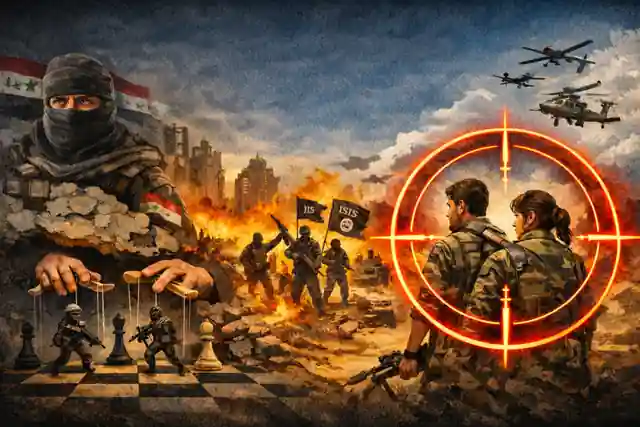
The wars of the last twenty years in the Middle East did not develop randomly. What has happened along the Iraq–Syria line is a planned chain of conflict progressing through interconnected phases. This chain has three main engines: the underground withdrawal of cadres left over from Baathist systems, the proxy networks of regional and global powers, and the fact that the Kurds’ refusal to become anyone’s soldiers has placed them on the target board.
1) Saddam’s paramilitary mind went underground
Saddam Hussein created a paramilitary force in case of an attack against him or his country. This force was positioned within the Republican Guard. After Saddam’s execution, these cadres did not disappear; they retreated into underground shelters established across the endless desert belt of Iraq’s Anbar province. This retreat was not merely hiding; it was a period of reorganization, expanding cadres, war preparation, and planning.
In this process, financial and logistical channels were operated with Qatar’s support and through Turkey. The silence was not a state of weakness; it was a period of accumulation for a “bigger return” to the field.
One of the critical turning points on the Iraq side of this chain is the Basra line between late 2011 and the summer of 2013. During this period, the Turkish consulate in Basra became a transit point where contact was established with post-Saddam underground networks and ISIS’s core formations; a groundwork was sought through Basra to produce a sectarian rupture in southern Iraq.
2) The attempt to trigger sectarian conflict and the Shiite response
In the next phase, an attempt was made to ignite a Sunni–Shiite conflict around Basra. But the Shiites showed a very strong response. This response quickly turned into a military-political capacity. What is known today as Hashd al-Shaabi became a new reality that shifted the balance in Iraq.
3) ISIS: the Mosul plan, the turn toward Kurdish cities, and a “mathematical error”
In the following phase, with Turkey’s military support, the organization that emerged under the name ISIS declared a caliphate under the identity of the “Islamic State of Iraq and al-Sham” and seized a large part of Iraq, including Syria.
The “Turkish” use of the name ISIS is not a coincidence. The emergence of this organization was shaped through long discussions and planning between Turkish consular elements working in Mosul and Saddam’s paramilitary structures. The organization’s name was circulated in Turkish form; although ISIS became widespread in English, Turkish media outlets deliberately promoted the term “DAESH.” The aim was to make the Turkish-origin nature of the name “ISIS” invisible and to cover the traces. For this reason, the correct usage is ISIS.
The expectation of states like the U.S.—especially the CIA—was that ISIS would directly topple the Assad government and then complete the unfinished work in Iraq and turn toward Iran. But on the ground, the organization took Turkey’s priorities into account and turned toward Kurdish cities. The CIA made a simple “mathematical error” here: it underestimated the Kurds’ organized defense capacity, social mobilization, and wartime resilience.
When the Kurds crushed ISIS, the intensity of ISIS attacks that had spread across the world also visibly declined. Aside from a few isolated attacks, the large, well-known ISIS attacks receded and lost their impact. During that period, discourse praising the Kurds rose across world public opinion; Kurdish resistance found the place it deserved in the shared conscience of humanity. Yet the game-makers did not accept this picture. By stretching time, slowly eroding perception, they waited until they could push the Kurds into a “marginal” position in the public eye. Looking at today’s developments and at the silence of people around the world, we can see more clearly that they waited for the right moment—and that even this kind of silence was calculated.
4) The HTS line and “rebranding”: Jolani → Ahmed al-Sharaa
The structure that completed its preparations in Idlib appeared on the scene as HTS and continued the war against Assad. In this process, another front was opened: the front of perception and legitimacy.
When they rapidly placed Jolani in Damascus, they first put him in a suit and gave him a neat shave; then they introduced him to the world under the name “Ahmed al-Sharaa.” The aim was to cover up the crimes against humanity committed under the identity of Jolani and to deceive humanity with a “clean” profile. This is not a transformation; it is a mask.
Like Baghdadi, Jolani is a remnant of Baathist regimes; both were cadres who did not hesitate to commit massacres when needed for Baath.
5) Information pollution is a conscious strategy
The biggest reason people cannot understand what is happening in the Middle East today is information pollution. This pollution is not random; it is produced consciously. Turks and their allied gangs especially enlarge this fog curtain. Anyone who does not read the process backward, as a chain, cannot correctly understand today’s developments.
6) For Turks, the Imrali process: the aim was not peace, but to stall the Kurds
Just as Turkey will never accept its occupation in Northern Kurdistan, it did not and will not allow the formation of any development concerning Kurds anywhere in the world. The expectation of the process they initiated in Imrali with Kurdish People’s Leader Abdullah Öcalan was not peace; it was to place the Kurds into a state of expectation and ensure that the great war that would begin in Syria was overlooked.
Kurdish People’s Leader Abdullah Öcalan made this clear in the talks: either the democratic republic project I present, or you will accept the solution imposed by the U.S.
I will not explain the idea of the democratic republic at length here. The main question is this: what is the solution imposed by the U.S.? The U.S. will strive not to lose the regional front of World War III in this region through proxy wars; it will win by setting peoples against one another.
7) Putting Kurds in the crosshairs: “we will not be anyone’s soldiers”
At different stages, the Kurds were offered wars on behalf of others. In Imrali, the Turks offered the Kurds a war against Israel, but Kurdish People’s Leader Abdullah Öcalan clearly stated that he would not give any people an order to fight for other states.
At that time the Kurds were allied with the U.S. In that case there were two paths: either the Kurds would be left without status, or they would be allowed to have status in Rojava as in Southern Kurdistan. When the U.S. idea of eliminating Iran became clear, Turkey’s demand also grew: that the Kurds not remain with status anywhere. Over time, the U.S. accepted this.
The U.S. held long-running talks, but each time it asked the Kurds to move together with them and unite against the Shiites. Earlier, they also wanted them to fight against Assad. The Kurds rejected this; they said they would defend only their own people.
8) The final stage: inciting a Kurdish–Arab conflict and narrowing Rojava
Some Arab states and the Sharaa line, which contacted Trump, declared that they accepted Israel’s demands; major financial commitments were put on the table in return. Trump wanted both to put his plan into motion and to obtain financing for the war he would wage.
They offered the Kurds war first against Hashd al-Shaabi in Iraq and then against Iran. The Kurds again said the same thing: we will not be anyone’s soldiers; we will only protect our own people.
As this refusal and the months-long work of Turkish intelligence began to yield results, Qatar opened the purse. Through Turkey, Arab tribes that had moved together with the Rojava administration were forced to switch sides. Finally, the Shammar tribe declared its betrayal. When Arab tribes switched sides, a part of the Arab fighters within the SDF also switched sides. For this reason, it became clearer that the Arab cities under SDF control were not under Kurdish forces, as some claim, but under the sons of the local people. Yet since the day the war began, HTS–DAESH and the occupying Turkish army have not captured a single Kurdish village. Thus, the area described as “Northern Syria” effectively dissolved; what remained was Rojava, the land of Rojavaê Kurdistan, consisting of the cities where Kurds live.
In recent days, with the resistance of the Rojava armed forces YPG and YPJ, people and armed forces from other Kurdish regions have begun sending aid; a spirit of mobilization has risen across the four parts of Kurdistan. Because the Kurds did not approve a Kurdish–Shiite war, the Turks now want to reach their goal by provoking a Kurdish–Arab war. The aim is to make it easier for the Kurds to be eliminated after Iran’s collapse, and by not wanting a strong Arab country to exist alongside them, to kill three birds with one stone.
Note: In this text I did not separately address Israel’s role and the France–Germany–United Kingdom line. I will examine the place and impact of these actors in the process in a separate text.
AZAD BADIKI – 21-01-2026