
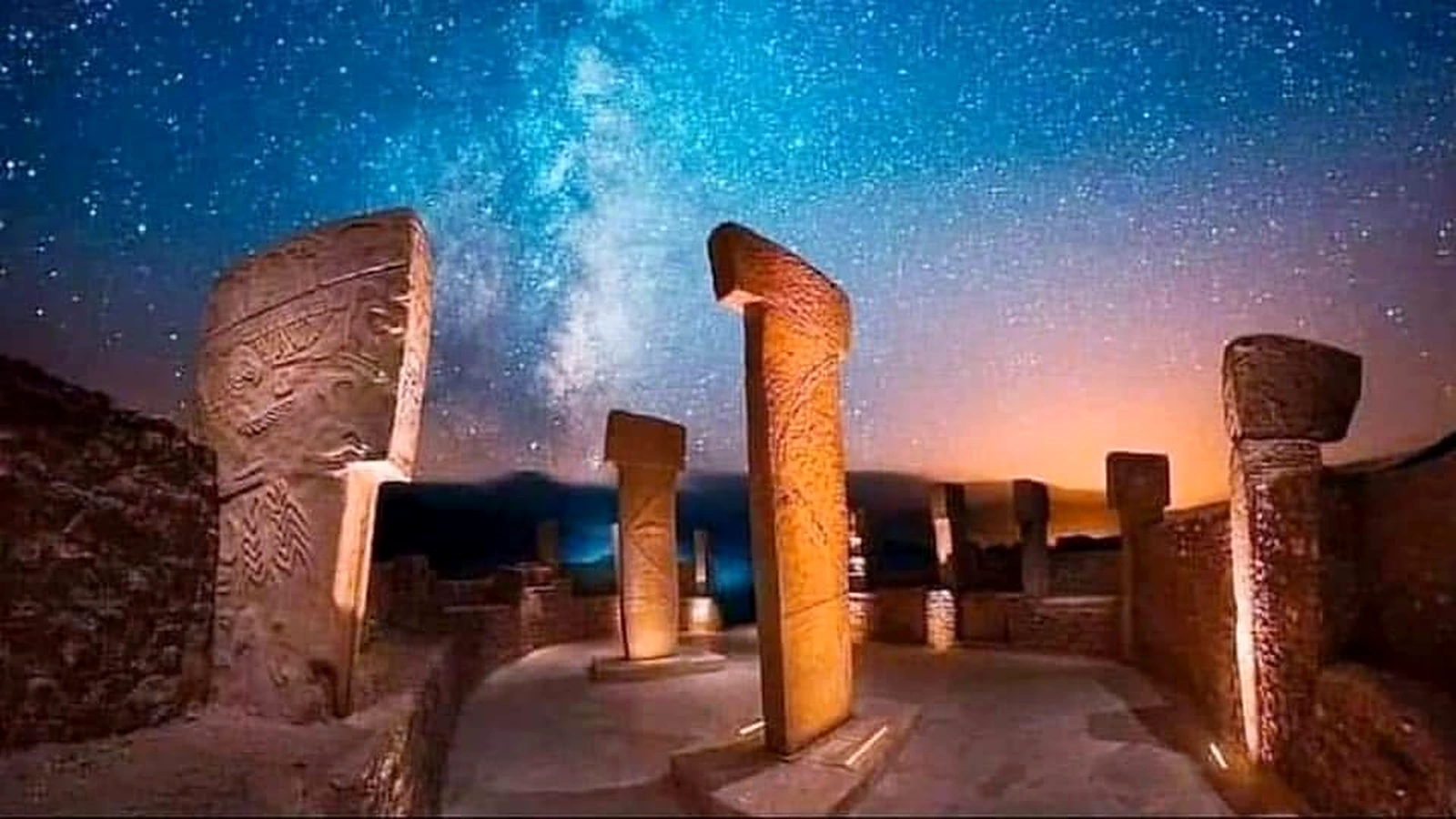
Rising from the plains of Şanlıurfa (Riha), a hill holds what is now known as the oldest temple complex in human history. Built some 12,000 years ago, before agriculture itself had begun, the found structure rewrote everything archaeologists thought they knew. The world recognises this site today as "Göbekli Tepe." Yet for centuries, the people who actually live in the region have called it by another name: Xerabreşkê.
In Kurdish, xerab means "ruin," and reşk means "sacred." In the language of the local population, the site is, quite literally, the "Sacred Ruin." The conclusion Klaus Schmidt's team reached only after the 1995 excavations, that this was a temple, had already been encoded in the local name for centuries. The Turkish "Göbekli Tepe" by contrast, refers merely to the physical shape of the hill: a swollen, belly-like rise in the landscape. It says nothing about the sanctity, function, or meaning of the place.
How the Name Entered the Academic Record
Contrary to popular belief, the label "Göbekli Tepe" was not Klaus Schmidt's choice. The name entered the academic record in 1963, through a joint project between Istanbul University and the University of Chicago called the "Prehistoric Research in Southeastern Anatolia." During a surface survey, the American archaeologist Peter Benedict documented the hill. He failed to recognise its true nature, dismissed it as an ordinary Neolithic burial mound, and no one returned to the site for three decades.
But the name was given: Göbekli Tepe.
The 1960s were a period in which Kurdish was effectively banned from public use in Turkey, and "there is no such thing as a Kurd" was official state doctrine. Through Law No. 5442 on Provincial Administration (1949) and the Specialised Committee for Name Changes established in 1957, thousands of place names (Kurdish, Armenian, Greek, Syriac) were being systematically Turkified. In such a climate, it would have been unthinkable for a joint American-Turkish project to enter a Kurdish name into the academic record.
Did Schmidt Know?
In 1994, Klaus Schmidt revisited Benedict's old reports and returned to the region. Excavations began in 1995. Schmidt spent years living in Şanlıurfa (Riha), working on the site every day alongside local labourers, most of them Kurdish. It is practically impossible that he did not know the name the people of the region used for the hill.
And yet, in every publication, every lecture, every book he produced, he wrote only "Göbekli Tepe."
This silence does not stem from any explicit threat, but from the way the system functions. In Turkey, excavation permits are issued by the Ministry of Culture and renewed annually. Foreign archaeologists work under joint protocols with Turkish universities. Schmidt was responsible not only for his own career, but for the entire Turkish operation of the German Archaeological Institute (DAI). To foreground a Kurdish name unrecognised by the state in official publications would have meant non-renewal of permits, visa complications, and the withdrawal of Turkish partners. The social sciences have a term for this: anticipatory obedience. The perpetrator does not need to apply pressure; the victim censors themselves.
Is This Merely a Question of a Name?
When Raphael Lemkin, the lawyer who coined the term "genocide," defined the concept in 1944, he included not only physical extermination but also the systematic destruction of a people's language, names, institutions, and cultural memory. Lemkin's original concept encompassed "cultural genocide." The 1948 UN Convention, under pressure from colonial states, narrowed the definition and excluded symbolic destruction. The concept itself was politically pruned.
The erasure of Xerabreşkê fits Lemkin's original definition with uncomfortable precision. Severing a people's connection to its millennia-old geography, changing the names of places, fixing academic literature with new ones. These are not routine administrative acts, they are instruments for destroying cultural continuity. The one who knows a place's name is the one in relationship with it. When the name is erased, the evidence of the relationship is erased with it. The next generation simply assumes "it has always been called this."
A Crime Against Archaeology Itself
The irony runs deep: the name Xerabreşkê already contained the knowledge that archaeologists struggled to reach only after 1994: that this was a temple. The word reşk, meaning "sacred," directly expressed the function of the site. The local population knew the nature of the place thousands of years before the academics did, and they encoded that knowledge in their language.
Local memory is one of archaeology's most valuable resources. The popular name of a place, its folk tales, its rituals… these often carry information that excavations cannot reach. To close off this source for political reasons is a crime not only against a people but against the shared knowledge heritage of humanity. In erasing the name Xerabreşkê, the Turkish state destroyed not just Kurdish cultural memory, but archaeology's own working material.
The Price of Silence
Today, millions of people around the world watch documentaries, read books, and publish articles about "Göbekli Tepe." It appears on the UNESCO World Heritage list under that name. None of them know that the local population has called this place the "Sacred Ruin" for thousands of years. This ignorance is not accidental, but it is the result of an institutional choice.
Sevan Nişanyan's book ‘The Country That Forgot Its Name’ is one of the few works documenting the place-name changes in Turkey; the author paid for it with prison and exile. Writing about the subject remains a personal risk. Most academics stayed silent, and stay silent still. The covenant of silence continues.
The Xerabreşkê question is not about a single name. It is about the connection a people built with a place over twelve thousand years, about the word that bore witness to that connection, and about how academic institutions and state policy worked together to erase it. This is not metaphorical: it is, in the most literal sense, the murder of history.
A temple was unearthed. A name was buried. The silence continues.
This article aims to open up discussion about the structural problems surrounding the Xerabreşkê / Göbekli Tepe question. The gap between the official name of the site and its local name is not merely a linguistic issue, but a question of cultural memory and historiography.