
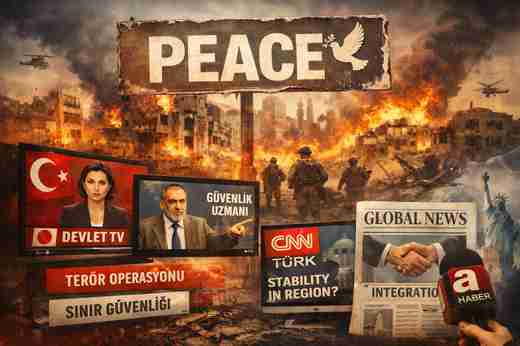
The attacks on Sheikh Maqsoud and Ashrafieh in Aleppo are not only a conflict in which weapons speak; they are also an information war in which words, concepts, and the boundaries of what is considered “normal” are decided. Every escalation on the ground is repackaged the next day on screens and in news texts through ready-made frames such as “stability,” “security,” “counterterrorism,” and “integration.” That package often makes the attack itself disappear—while reducing the right to life and political agency of those under attack to a secondary footnote.
At the center of this information war stands the language engineered by the Turkish state. Its power does not come only from being broadcast by state outlets, but from producing a template that large segments of society accept as “reasonable” and “ordinary.” The template is simple: organized Kurdish political will is coded as a “security threat,” while Kurds as a people are individualized, depoliticized, and pushed toward disorganization. In this model, “Kurds” appear on television, but concepts such as organized rights-claims, local democracy, self-defense, political representation, equal citizenship, and legal guarantees are kept out of frame. Even the translation of Turkish insults and contempt into Kurdish—then circulated back into Kurdish-language space—belongs to the same logic: the aim is not to support Kurdish language, but to use Kurdish language to weaken Kurdish agency.
This is not the work of a single channel. State broadcasters, pro-government mainstream media, “expert” commentators, security-aligned think tanks, and coordinated social media networks carry the same storyline in different packaging. One performs blunt propaganda; another speaks in the tone of “moderate analysis;” a third adopts the language of “humanitarian concern.” Yet the shared objective remains: an attack becomes an “operation,” an occupation becomes a “security measure,” and a people’s resistance becomes a “clash.” When the words change, the moral frame changes with them. An assault that tramples human dignity is suddenly debated as “stability,” while civilian deaths and displacement are treated as “unavoidable side effects.”
The seepage of this template into global media often feeds on asymmetries of access and sourcing. International agencies and foreign correspondents, pressed for speed and proximity, frequently begin with “official statements” and “easily accessible sources,” and the first frame is set there. Then that frame is reinforced through diplomatic messaging, security commentators, and repetition under the banner of “balance.” As a result, the language of “peace,” “integration,” and “stability” grows—while the security of Kurdish civilians, local self-government, political representation, language and identity guarantees, and civilian protection mechanisms shrink.
But what is at stake in Aleppo and across Kurdish regions of Syria is not an abstract notion of “security.” It is the concrete protection of civilian life. An information war is not only about telling lies; it is a struggle over what becomes visible, what is treated as legitimate, what is labeled “extreme,” and what gets normalized. That is why marketing attacks under the label of “peace” is not merely political manipulation—it is also an assault on dignity that denies the reality of people’s suffering. This text begins precisely here: to expose the language that launders attacks as “peace,” to keep civilian reality at the center, and to restore the Kurdish people’s status as political subjects—not as objects of someone else’s narrative.
Azad Badiki
20-01-2026